
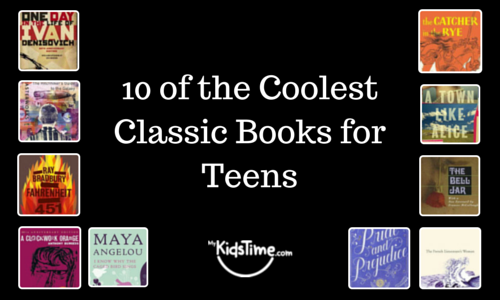
Classic books can easily get overlooked when we think about what teens are reading. But some stories simply stand the test of time — they’re the ones teens tend to remember long after they’ve put them down, almost a literary rite of passage. Here are 10 of the coolest classic books for teens, a mix of the darkly funny, the deeply moving, and the downright unforgettable.
#1. The Hitchhiker’s Guide to the Galaxy
 One Thursday lunchtime, Earth is unexpectedly demolished to make way for a new hyperspace bypass. For Arthur Dent, whose house was demolished that same morning, this is already more than he can cope with. Sadly, the weekend has only just begun — and the galaxy is a very, very large and startling place indeed.
Douglas Adams’ The Hitchhiker’s Guide to the Galaxy became a cult classic when it was first published and continues to sell around the world. It introduced unforgettable characters like Arthur Dent, Marvin the Paranoid Android, Zaphod Beeblebrox, and of course the Vogons, and remains one of the funniest, most irreverent novels ever written.
#2. Pride and Prejudice
 “It is a truth universally acknowledged, that a single man in possession of a good fortune, must be in want of a wife.”
So begins Pride and Prejudice by Jane Austen, arguably one of the greatest classics of all time. Her novel of manners and mores in early nineteenth-century England centres on the sharp-witted Elizabeth Bennet and the proud but principled Mr Darcy, who start out as adversaries and slowly develop a grudging respect that blossoms into love.
#3. Fahrenheit 451
 Ray Bradbury’s Fahrenheit 451 is set in a dystopian, post-literate future. Guy Montag is a fireman — but his job isn’t to put out fires, it’s to burn books, which are forbidden as the supposed source of all discord and unhappiness. Even so, Montag is unhappy, and there is discord in his own marriage.
Alongside Orwell’s 1984 and Huxley’s Brave New World, Fahrenheit 451 stands as one of the great prophetic accounts of a society enslaved by media, conformity, and the suppression of ideas.
#4. The Catcher in the Rye
 J.D. Salinger’s The Catcher in the Rye is the archetypal coming-of-age novel. Trying to escape the hypocrisies of life at his boarding school, sixteen-year-old Holden Caulfield seeks refuge in New York City.
Throughout, Holden picks apart the “phony” aspects of the adults and institutions around him — from the headmaster whose warmth depends on a family’s wealth, to his roommate’s shallow charm with girls. Written in a loose, slangy, unmistakably teenage voice, the novel’s power comes less from plot than from its razor-sharp observations about growing up, loss, and expectation.
#5. I Know Why the Caged Bird Sings
 I Know Why the Caged Bird Sings captures the loneliness of childhood, the brutal insult of prejudice, and the way words can make the world feel right again. Maya Angelou’s debut memoir is a modern American classic loved the world over.
Sent by their mother to live with their devout, self-sufficient grandmother in a small Southern town, Maya and her brother Bailey endure the pain of abandonment and the local bigotry around them. At just eight years old, back with her mother in St Louis, Maya is attacked by a man many times her age — and has to live with the consequences for the rest of her life.
Years later, in San Francisco, Maya discovers that love for herself, the kindness of others, her own resilience, and the words of great writers (“I met and fell in love with William Shakespeare”) will set her free. Poetic and powerful, it’s a memoir that continues to touch hearts and change minds.
You may also like: 25 Books for Teens Guaranteed to Keep Their Nose Buried in the Book
#6. The French Lieutenant’s Woman
 The French Lieutenant’s Woman by John Fowles is an unconventional love story. Charles Smithson, a respectable engaged man, meets Sarah Woodruff as she stands on the Cobb at Lyme Regis, staring out to sea. Charles falls for her, but Sarah is a disgraced woman, and their romance will defy every stifling convention of the Victorian age.
Widely acclaimed since its publication, it remains one of Fowles’ best-loved novels.
#7. A Clockwork Orange
 Anthony Burgess’s A Clockwork Orange is as brilliant, transgressive, and influential today as it was on publication. A nightmare vision of the future, told in its own fantastically inventive slang, it has become a true classic of modern literature — and the basis for Stanley Kubrick’s controversial film adaptation, which introduced the story to an even wider audience.
#8. The Bell Jar
 A vulnerable young woman wins a dream assignment on a big-time New York fashion magazine and finds herself plunged into a nightmare. An autobiographical account of Sylvia Plath’s own mental breakdown, The Bell Jar is more than a confessional novel — it’s a searing, sometimes darkly funny statement on what happens to a woman’s ambitions in a society that refuses to take them seriously.
#9. One Day in the Life of Ivan Denisovich
 In the aftermath of World War II, a dutiful Russian soldier is wrongfully convicted of treason and sentenced to ten years in a Siberian labour camp. This masterpiece of modern Russian fiction by Aleksandr Solzhenitsyn is a harrowing account of a man who endures with quiet dignity and strength.
First published in 1962, it’s considered one of the most significant works ever to emerge from Soviet Russia — a graphic picture of life in a labour camp and a moving tribute to the human will to survive.
#10. A Town Like Alice
 Nevil Shute’s A Town Like Alice is a tale of love and war. Jean Paget, a young Englishwoman living in Malaya, is captured by the invading Japanese and forced onto a brutal seven-month death march with dozens of other women and children.
During this ordeal, she meets Joe Harmon, a young Australian soldier who risks his life to help the women and children and is caught and punished for it. Years after the war, back in England, an unexpected inheritance inspires Jean to return to Malaya to give something back to the villagers who saved her life — and she learns that Joe survived after all. Her search for him leads her to a remote Australian outpost called Willstown, where she finds a new challenge that draws on all the resourcefulness that carried her through the war.
Frequently Asked Questions
What makes a book a “classic” worth giving to a teenager?
A classic earns its place because it still says something true decades — sometimes centuries — after it was written. These ten cover very different worlds and eras, but each one has a voice, a question, or a character that still resonates with teen readers today.
Are all of these books suitable for younger teens?
Some deal with heavier themes — war, mental health, prejudice, dystopia — so it’s worth a quick look at the blurb or a parent review site if you’re choosing for a younger or more sensitive teen. Many are commonly read as part of secondary school curricula, so a chat with your teen’s school or librarian can help with timing.
Where can I get hold of these books?
All ten are widely available secondhand, in libraries, and through most bookshops and online retailers. Your local library is a great free starting point if you want your teen to try one before committing to buying it.
Do I need to read these in order?
No — each is a standalone novel, so your teen can start with whichever title appeals most.
Related Articles
- 25 Books for Teens Guaranteed to Keep Their Nose Buried in the Book
- Great Book Series for Tweens and Teens
- How to Get Reluctant Teen Readers Excited About Books
Save These Ideas
Not read all ten yet? Bookmark this list and work through them at your own pace — or share it with a teen reader who’s after their next great read.
Never Miss an Idea
Want more reading inspiration, activity ideas, and things to do with your kids delivered straight to your inbox? Sign up for our free newsletter for fresh ideas every week.
What’s your all-time favourite classic? Which book would you add to this list? Tell us in the comments below.