
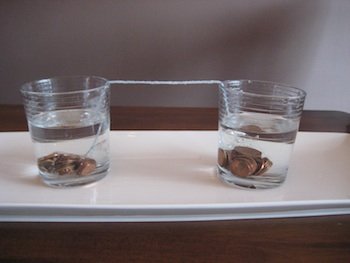
Ever wondered how stalactites and stalagmites form in caves? This simple science experiment for kids brings that slow, magical process right onto your kitchen counter — and it’s one of our favourites for curious minds who love to watch something change over time.
All you need is a few household bits and a little patience. Over several days, your child will watch crystal “icicles” grow downward and matching mounds build up beneath them, just like in a real cave.
What you’ll need
- Two jars or glasses
- Water
- Epsom salts
- String
- Small weights
- A plate
How to conduct the stalactite and stalagmite experiment
1. Fill two jars with warm water. Mix in Epsom salts until no more will dissolve.
2. Wet the string and tie a weight to each end (small coins wrapped in cling film work well).
3. Drop one end of the string into each jar.
4. Put a plate between the two jars, with the string hanging over the plate.
5. Check at least once a day to see if stalactites and stalagmites have formed.
The Epsom salt solution travels slowly along the wet string and drips onto the plate. As the water evaporates, it leaves tiny salt crystals behind — building down from the string as a stalactite, and up from the plate as a stalagmite. It won’t happen overnight, so encourage your child to check in each day and note what’s changed.
How do you know which are stalactites and which are stalagmites?
Here’s an easy way to remember which is which:
Stalactites hold on tight — they hang down.
The mighty stalagmites stand up tall.
Frequently asked questions
How long does it take for stalactites and stalagmites to form?
It varies, but most families start to see crystal formations within a few days. Leave the jars undisturbed and check once a day — patience is part of the fun.
Is this experiment safe for young children?
Epsom salts are generally safe to handle, but adult supervision is recommended, especially when preparing the warm water and salt solution.
Can I reuse the jars and string afterwards?
Once the experiment is finished, you can rinse and reuse the jars. The crystal formations are delicate, so handle them gently if you want to keep them for a closer look.
Why does the string need to be wet first?
Wetting the string helps the salt solution travel along it steadily by capillary action, so the “stalactite” forms gradually rather than the liquid just dripping straight through.
More science fun to try
If your kids enjoyed this one, they’ll love more hands-on science experiments for kids to try at home — simple, screen-free ways to keep young scientists busy and curious.
Save this for later
Love this idea? Save this page or bookmark it so you’ve got it ready next time you need a rainy-day activity or a screen-free afternoon project.
Want more ideas like this?
Sign up for our free newsletter for a regular dose of activity ideas, competitions and offers straight to your inbox — it’s free, and it’s packed with things to try with the kids.
[[IMG:1]]
—