
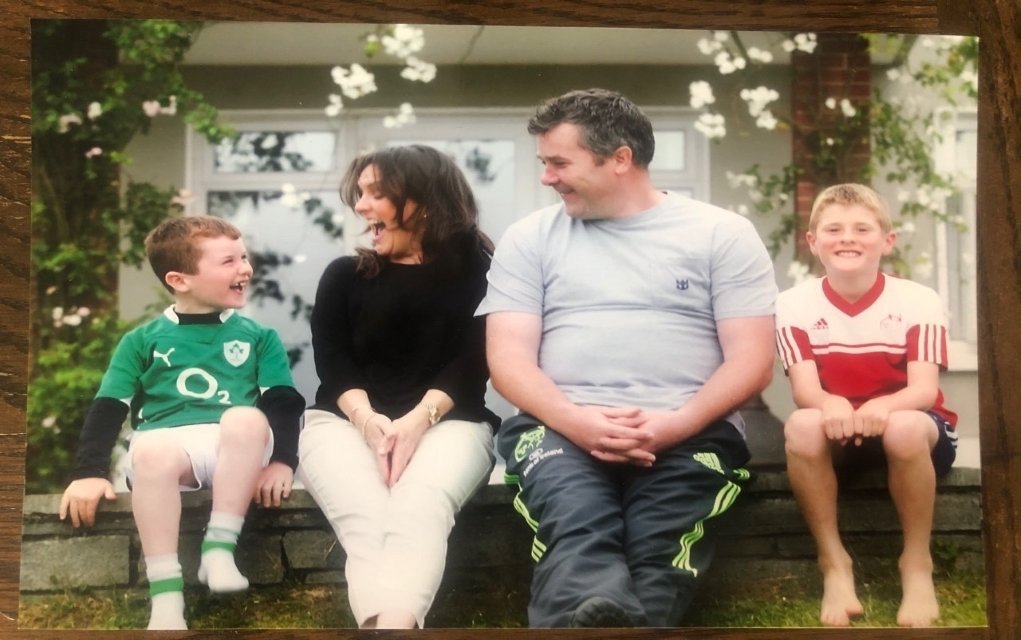
Olive Foley is the widow of the late Munster Rugby player Anthony ‘Axel’ Foley, and mum to two young boys. She lost Anthony suddenly and without warning, leaving a void that is hard to fill. Her family found support through the Children’s Grief Centre in Limerick, and here Olive shares her story of living with loss.
Living With Loss: Olive Foley, Widow of Munster Rugby’s Anthony ‘Axel’ Foley
When We Experience Loss, We Experience Grief
“Many of you have experienced loss. Mine is no greater than any of yours. But losing Anthony with no notice — my husband, my confidant, my best friend, but perhaps most of all the father of my children — created a void that’s impossible to fill.
Having family around has helped me deal with the pain. I have a great family: my immediate family, Anthony’s family, my family of friends, my family of faith, and my family of church. All of these are essential for us.
I also had the support of the sporting community. In those darkest hours, the arms of that family wrapped around me and my family in a way that was remarkable, and have done ever since.”
Knowing What to Do and What to Say
We also had support from the Children’s Grief Centre in Limerick. They give bereaved children the space to deal with their upset in a safe, open and confidential environment.
“We have been through extremely tough times. My sons are doing okay, largely thanks to the help of Helen Culhane. Helen, founder of Limerick’s Children’s Grief Centre, has helped to open up conversation within the family about Anthony’s life and death.
As I was grieving myself, it was a great help to hand the children over for that hour, knowing they would be listened to and cared for, and that their needs would be met.
I just needed to know what to do with the kids — what was right and what was wrong — and the kids needed support themselves.
It was new to me, and a real learning curve. I didn’t know how to deal with grieving children myself. The support I got, as well as the boys, has helped the children — and me — through it.”
Let’s Talk About Dad — Keeping Anthony’s Memory Alive
“What I love about Helen and all the support team she has, is the way she deals with the children. They go in and sit down one-on-one. Then we’re brought in for the last ten minutes, so inevitably they’ll have spoken about Dad, or told little stories, and Helen might say something like, ‘Tell Mam about that great story’.
The way Helen introduces parents to the conversations she’s had privately with the children has helped us as a family to talk about the subject. She’s able to unify and open up the conversation. So now I’m talking about Dad to the children, instead of, ‘Let’s pretend this never happened, don’t mention Dad because everybody’s going to cry’.
Now I talk quite freely to the children about Dad. We were able to continue the conversation on the way home in the car, and then next thing we’re talking about him morning, noon and night, because he comes up in conversation constantly.”
What the Children’s Grief Centre Has Meant for Us — and How It Can Help Others

“Helen and her team have supported the kids and really seen them through a very difficult time. I have seen first-hand the work she does.
It is quite extraordinary to be able to give children a beautiful place where they can go, and express themselves through talking, through art, and all these different lovely mediums. She and her staff do incredible work.
Children who are bereaved through death, separation or divorce will often need somewhere they can go and be heard.
What I have seen with my children is they go in to see Helen, sit down, and talk mainly about themselves, do drawings, and express emotions. They are stronger children as a result of that, I do believe.”
If you need support following a loss through bereavement, separation or divorce, please contact the Children’s Grief Centre. You can do this by visiting their website, calling 061 224627 / (087) 9851733, or emailing [info@childrensgriefcentre.ie](mailto:info@childrensgriefcentre.ie).
You can also make a difference in the life of a grieving child by making a donation to their Building Project. Any donation, no matter how small, supports their work with children, young people and families. The service is free to access and provides a safe place for children aged 4 to 18 who have experienced loss through bereavement, separation or divorce.
Frequently Asked Questions
What is the Children’s Grief Centre?
The Children’s Grief Centre is a Limerick-based service that supports children and young people aged 4 to 18 who have experienced loss through bereavement, separation or divorce. It offers a safe, confidential space where children can talk, draw and express their emotions with trained support staff.
How can the Children’s Grief Centre help my family?
The centre works one-on-one with children, then brings parents into the conversation, helping families talk openly about loss instead of avoiding the subject. Olive Foley found this approach helped her sons process their grief and helped her know how to support them at home.
Is the Children’s Grief Centre service free?
Yes, the service is free to access. The centre relies on donations to continue its work and fund its Building Project.
How do I contact the Children’s Grief Centre?
You can reach the centre through their website, by phone, or by email — details are included above in this article.
You Might Also Like
- Supporting a Child Through Grief and Loss
- Talking to Children About Death and Bereavement
- Building Family Resilience After a Difficult Loss
Don’t Miss Out on More Family Stories
Want more real stories and practical support for family life? Sign up for our newsletter and we’ll send you helpful ideas, articles and resources straight to your inbox every week.