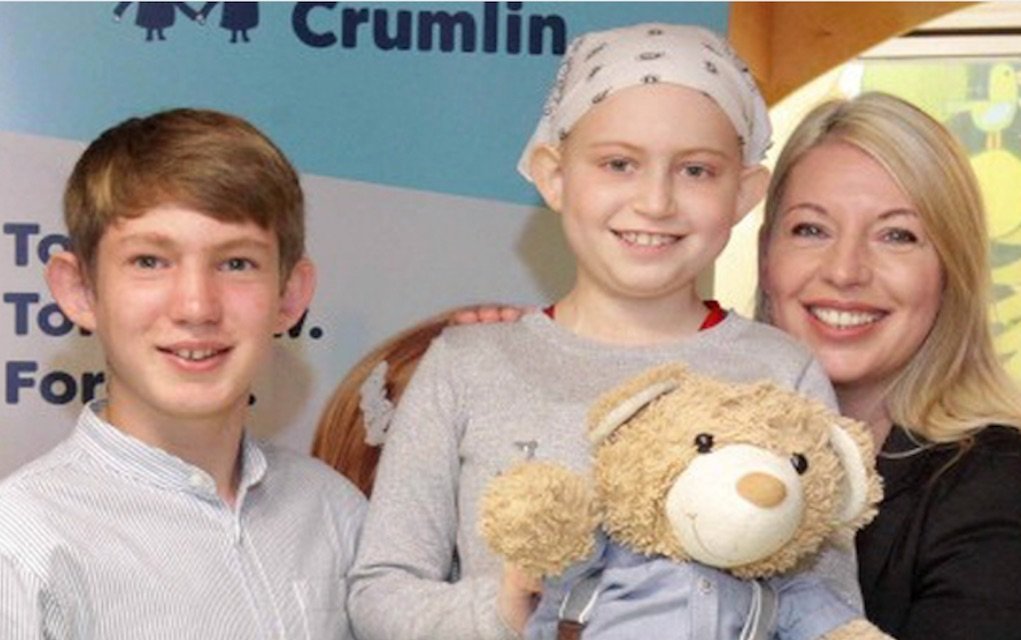
Most families never have to face the terror of a life-threatening diagnosis for a child. Fewer still have to face it twice. But that’s exactly the situation Noreen Doyle found herself in. Here, Noreen shares her family’s story of positively living with childhood illness.
One Family’s Story of Living with Childhood Illness
Three years ago our lives took a new direction. My youngest child Kate, who was seven at the time, was unwell. Nothing unusual — she had a temperature, she was tired and pale. In any other family it would probably not be of major concern, but in ours, I knew. I had known in my gut for a few days, but was terrified to face it again.
My second son James was 18 months old when he became unwell. As with Kate, it was nothing major at first — just recurring chest infections and the general things a child that age would pick up.
He had turned two on December 22nd, and by the middle of January he was really sickly, pale and lethargic. I brought him to my GP, who referred him to Crumlin that afternoon. Many hours later, he was diagnosed with leukaemia.
Treatment
James was very sick, so he was admitted straight away and put on blood and platelet transfusions for several days.
He had many setbacks. He stopped walking and was in a wheelchair for a while. He really struggled for the first three months of his treatment and spent a lot of time in Crumlin. My first child, who was three at the time, was sent to my family in Cork for a while because we were in the hospital with James.
It was a challenge, and it took more than four years for him to become well again. But he did get well, and is now an amazing child — and we settled back into life as a normal family again.
Until April 22nd, 2017.
Could It Be Happening Again?

For a few weeks in March and April 2017, my fourth child Kate started getting high temperatures. Then she started taking little naps during the day, she was looking pale and lethargic, and I just knew straight away.
For the first few days I was in denial about the whole thing. I just thought, “No, this cannot be the same thing. It just cannot be the case.”
I brought her to the same GP. She said, “Not a hope, lightning never strikes twice,” before referring us to Crumlin again.
Diagnosis
We arrived into A&E and I said to them, “Look, just do the bloods on her as quickly as you can, because I have a gut instinct with our history.”
Within two hours they told us she looked like she was presenting with leukaemia too.
Professor Owen Smith had been James’s doctor, so I texted him straight away from A&E and said, “I think we’re in trouble. I need help.”
He rang me immediately and spoke with the doctors in A&E. He told me, “I’ll be in with you in the morning. We will deal with this together. We will make a plan.”
The diagnosis was more or less confirmed the following day. Then there were a number of tests to determine what type of leukaemia it was and what level she was at. We were sent home for two days to get everything together and digest it, then we packed our bags and came back in for a period of time. Luckily, Kate really did sail through her treatment.
How Research Helped
When James was in treatment, he took part in a research trial. Ten years later, the results of that trial had a direct impact on Kate’s treatment. We’re benefiting from the research James took part in.
The research that came out of James’s trial, and the years of work that followed, meant that Kate’s prognosis was better, the cure rate was better, and the treatment was shorter. The research James took part in shaved six months off the treatment Kate had to go through. Now, we’ve entered her into a new research trial that, hopefully, will benefit other children in years to come.
These trials are critical to the ongoing treatment and overall care of the child — to the overall quality of the life that child has. You must remember that while they are sick, they are still children.
The Impact Of Childhood Illness

Whilst they are diagnosed with cancer, you desperately want them to have some kind of quality of life. You don’t want the illness to rob them of their childhood if you can possibly help it.
It’s traumatic for them and for the whole family. It ripples out to everybody, into the community, to all the little ones in Kate’s class.
When Kate was diagnosed in April, she was due to have her First Holy Communion three weeks later. That had a real impact on the little girls in her class. The other mums were concerned and asked questions like “Will she look different? Will she have hair?” People who’ve never known a child with cancer just don’t know how to react. It causes a certain amount of anxiety.
Positively Living With Childhood Illness
Kate would tell you, despite everything, that she had the best summer ever, believe it or not. I’m a very positive person and I try to instil that in my children. I firmly believe that as a parent, you have to feed positivity to your children. They thrive on it.
If I’m going to be permanently worried and upset, Kate would pick up on that. Children are so intuitive. We have a very strong bond and we’re a very close family. From day one, we told her everything. We sat her down and said, “Do you know what, it’s crap. It’s not going to be easy, but we’re going to try and make it as tolerable as possible along the way, and you’ve got to work with us.”
She’s naturally bubbly and upbeat. So for every milestone and difficulty — like when she was getting her Hickman line in, or having some of the harder chemo — we’d organise for her to meet someone she wanted to meet, go to a concert, or do something to distract her and give her something to look forward to.
Reaching Out

I would have no qualms about asking people to help in times like that. People are fantastic. It meant that when she had memories of a tough procedure or a difficult injection, they were diluted with positive memories.
We’ve met a lot of rugby players. She has a particular soft spot for one of the Connacht and Ireland players, Bundee Aki. When she got sick, she made a list of the things she wanted to do and the people she wanted to meet — and she always said she’d love to meet Bundee Aki. I said, “OK Kate, I’m going to make that happen!”
It was coming up to her birthday, and she was back in hospital. I contacted him and asked if he could send her a card or a message. He made a gorgeous video for her, and I played it for her on her birthday. She cried with excitement.
A couple of weeks later she got to be the mascot for Connacht! She was in her element. Bundee Aki was fabulous with her, and so was John Muldoon. When she got out onto the pitch with the boys, she felt like the Queen of Sheba!
Since then, she really has thrived, sailing through her treatment with a hugely positive mindset.
Creating Positive Memories
If you acknowledge how awful the situation is, and do something to soften it, positive childhood memories can still be made. Having cancer becomes part of the story, rather than something that overwhelms it.
Kate loves Bernard O’Shea and the 2FM presenters. We got her into the studios one morning. She had a ball, was brought around the studios and met all the different DJs. People are just so good — and to put a smile on a tiny child’s face makes anyone’s day.
Our Amazing Community & School
The community reaction has been unbelievable. We live in a small community in Naas, and the school is a small country school. The principal was phenomenal, and the teachers were brilliant. The class made banners and cards and sent them into the hospital.
Kate would video call her teacher during the day, and some of the other school staff would join in too, always so supportive, sending in school work if she wanted it. Although she didn’t have to do it, it helped to keep things as normal as possible — she was treated very normally, while everyone was so protective of her at the same time.
All our neighbours and friends were fantastic, and we are so appreciative of the community we come from. When I went to Crumlin with Kate, the other mums started a dinner routine so that my husband and my other three kids at home were fed properly. We were in hospital for a few weeks, and when we came home our freezer was stacked full of beautiful dinners. I didn’t have to think about school pick-ups and drop-offs — they were just wonderful.
How CMRF Crumlin Helped

When James was getting his treatment, he was in the old St. John’s ward, before the CMRF Crumlin investment. The old ward and the new ward are worlds apart.
When we first came in with James, you’d be in a room divided in two by a curtain — one child and family on one side, another family squeezed into the other. There was no ensuite bathroom; you could be sharing a bathroom with up to eight other families. There was no privacy, and you slept on a fold-out bed.
With the help of CMRF Crumlin, families now have their own room and their own ensuite bathroom — a world of difference from what it used to be. Now, when we come in, we make the room our own with fairy lights, her own teddy bears and cushions, so it feels a little bit like home for her. There’s no comparison between the old and the new.
I’ve seen first-hand the benefit of the money CMRF Crumlin puts into both Our Lady’s and the National Children’s Research Centre. I wouldn’t wish a sick child on any parent, but if your child is ever sick, the best thing you can hope for is good research to help improve or cure their illness, and amazing staff and facilities to help them get better.
Noreen Doyle, mother of Kate and James Doyle
Every sick child deserves a chance. Please donate to CMRF Crumlin to support vital ongoing research, care and treatment for our children.
FAQ
How did research help Kate’s treatment?
Research from a clinical trial James took part in ten years earlier directly shortened and improved Kate’s treatment, cutting six months off her course and improving her prognosis. Kate herself has since entered a new research trial, continuing the cycle of research helping future children.
How can parents help siblings and classmates understand a childhood cancer diagnosis?
Honesty, age-appropriate explanation and keeping routines as normal as possible — school contact, video calls, cards and small gestures from classmates — all help children process what’s happening and stay connected to a sick child.
What role does community support play during childhood illness?
Practical support like meal trains, school flexibility and small acts of kindness from neighbours can lift enormous pressure off a family during hospital stays, freeing parents to focus on their child’s care.
How has hospital care for children with cancer improved in Ireland?
Investment from charities such as CMRF Crumlin has funded ward refurbishments, giving families private rooms and ensuite bathrooms in place of shared, curtained-off spaces — a significant improvement in dignity and comfort during long hospital stays.
Related Articles
- Supporting Your Child Through a Hospital Stay
- Talking to Children About a Sibling’s Illness
- Building a Support Network as a Parent of a Sick Child
Save This For Later
If this story resonated with you, save it or share it with a friend who might need it. Browse more real family stories and parenting support articles on MyKidsTime.
Get Weekly Ideas In Your Inbox
Sign up to the MyKidsTime newsletter for weekly parenting tips, family stories and ideas — straight to your inbox, no pressure, just useful stuff when you need it.