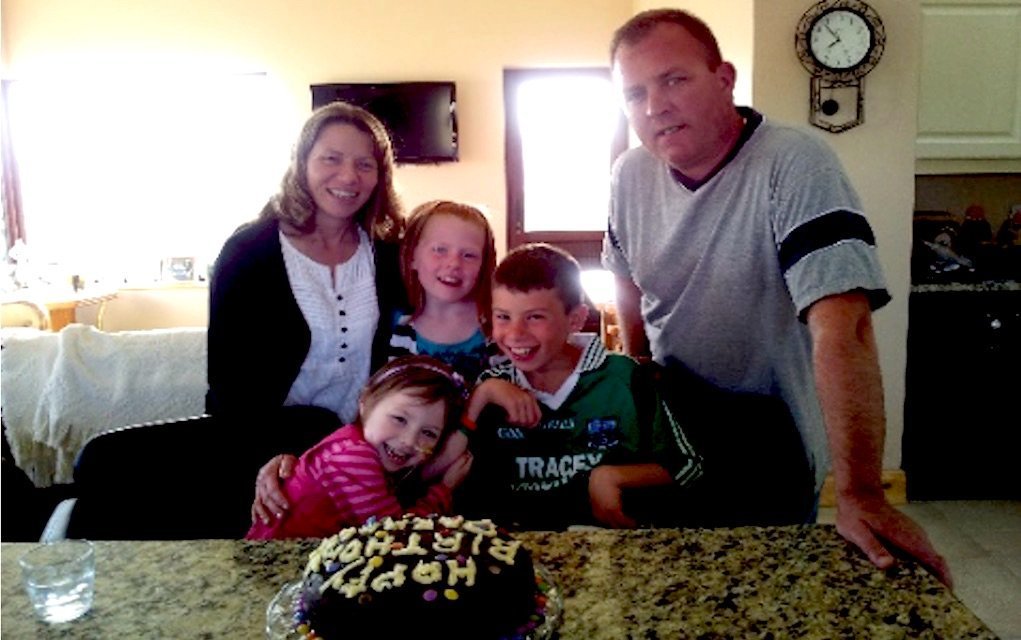
When Aideen was just 3 years old, she was diagnosed with Myelodysplastic Syndrome, a rare blood disorder that can be a precursor to leukaemia. This is Aideen’s story, told by her mum Rosie and by Charley, a volunteer with the charity Hand in Hand, which offers practical, hands-on support to families when they need it most.
Hand in Hand has been recognised as one of Mykidstime’s charity partners, celebrated for the everyday, practical support they give to families like the Conneelys. With the family’s permission, they shared Aideen’s story here.
Charley Brady, who volunteers with Hand in Hand, wrote this piece about Aideen’s story:
I think that you can tell a lot from a person’s kitchen. In fact, if I feel comfortable in the kitchen then I’m reasonably assured of being comfortable with the person who uses it. The room in question here is in a lovely home just outside Headford, north of Galway.
On the walls there are the signs of a happy home: drawings that the kids have done at school and which have been put up on spare surfaces, along with photographs of various family members. Comfortable, contented clutter comes to my mind.
And yes, I think that it’s safe to say that I liked this room straight away, as I did the owner Rosie Conneely, who has invited my colleague Jennifer and I into her home. In my case it’s for a chat; for Jennifer, it is to do a bit of catching up, because in the past the Conneelys have been a family that Hand in Hand has assisted through bad times.
Aideen’s Story

Rosie introduces me to Darragh (12) and his little sister Rachel (11). Later I’ll be meeting the small lady who is the reason for the visit, seven-year-old Aideen.
Rosie is a petite young woman, open and easy to listen to. There are times, though, that her soft Fermanagh accent hints at the steel and stubbornness in her makeup. As she relives her pain of previous years, I can see that these are qualities that have stood to her when she needed them most.
Aideen Had No Energy, “No Life”
In September 2010, Aideen was diagnosed with Myelodysplastic Syndrome, which can be a precursor to leukaemia.
“She just always seemed to be tired,” says Rosie. “It wasn’t right in a child that age. She had no energy, no life.”
Rosie lived through a frustrating — as well as what must have seemed like a never-ending — period of many months, when she seemed unable to get it across to those in charge that there was something seriously wrong with her little girl.
Some medical staff didn’t seem to be responding to the concerns of a very frightened mother. As Rosie says: “Even the neighbours were coming up to me and asking how she was; even the neighbours were noticing. And yet I just wasn’t being listened to.”
And you would think, wouldn’t you… you would think that maybe a grey complexion and bluish lips would set off at least a few alarms.
However, if some people didn’t listen and pay attention, there were others who did, and one of those was the junior doctor who enquired as to what treatment Aideen was receiving.
At this point it seems to have been mainly blood tests in May, followed by more of the same just before the schools closed in June; and then Aideen just got worse and worse over the summer.
“After I answered her questions, that junior doctor wanted to do further tests, and the result was that Aideen was brought straight to Galway Hospital and they kept her in. Then she was transferred to Crumlin Children’s Hospital. ‘You were right to be worried,’ I was told. ‘There’s something wrong with her blood.'”

“Her haemoglobin was at 5.8 when it should have been above 12, and then dropped even further to 4.9. That was when Aideen got her first blood transfusion. I was running around like a mad thing, trying to organise the other children and call my husband Gerry, who was working in England.”
I’m worrying at this point that I am opening up old wounds, but Rosie assures me that even now she has a need to talk about that terrible period. Still, I’m just a bit relieved when she tells me that she has to take a break for five minutes in order to collect Aideen.
The Silent Testimony of Walls
I sit there with Jennifer, thinking, not talking. Instead, I’m looking around that lovely kitchen again. Yes, it may have all the hallmarks and atmosphere of now being the happy centre of the Conneely household, but it has suddenly hit me that these walls have also been silent witness to an awful lot of agonising worry.
Suddenly what Rosie and her husband Gerry had gone through was coming into sharper focus.
Rosie is back by now and her anguish at the unexpected development — just when things seemed to be improving — of the Graft v Host disease is still raw and above the surface. “It shouldn’t have gotten to that, I told them.”
It’s odd watching the mix of emotions running through Rosie. Her face is a bit too expressive for her to even try to hide anger, but relief is there as well, in odd flashes of memory or trying to recall what doesn’t seem important.
“Was it St. Brigid’s Ward they put her in at first? I know that they had no beds in John’s Ward,” or “I remember that Trapattoni was visiting the kids…”
The minutiae of the agony that this woman and her husband went through are too much to include in an article like this, and that’s probably as it should be.
Rosie is full of praise for the staff who treated Aideen: “We met with Professor Owen Smith, and only for him Aideen wouldn’t be here. The nurses would tell me that he would even call at night to see how she was doing.”
Meanwhile, she had relented on her initial decision not to contact Hand in Hand, which is quite a common first reaction.
Hand In Hand: Offering Practical Support to Families

Rosie says, “I had been told about Hand in Hand in the hospital, but out of pride or whatever, we thought that we could do everything ourselves. Then there was a small thing, a mix-up with pickups for the kids, and that was it.”
In the end, she was put in touch with Josie, a professional carer and a lady that Rosie still raves about. “She really became a part of the kids’ lives. I’d come in exhausted and the dinner would be ready, the homework done, the kids happy. I can’t tell you how good she was. Josie just went beyond what she could have done, and the cleaning company came in regularly and cleaned the house throughout — it was just a joy to come home to. Week after week and month after month, the support was there for us.”
Aideen was in and out of hospital for several years, including an extended stay in intensive care, as she bravely fought the Myelodysplastic Syndrome that had taken hold of her body.
Thankfully, Aideen is doing well now, and the family no longer needs the services of Hand in Hand. But if your family needs support, Hand in Hand is there to help, offering a range of home support services that reduce some of the stress and anxiety that impact the whole family when a child is diagnosed with cancer. If you’d like to get involved by donating or sponsoring, you can contact them via their website.
Frequently Asked Questions
What is Hand in Hand?
Hand in Hand is a charity that provides practical, home-based support to Irish families of children with cancer — things like childcare, housework, and everyday help so parents can focus on their child’s treatment and the rest of the family.
How did Hand in Hand support Aideen’s family?
Hand in Hand arranged a professional carer to help with the children, homework, and meals, along with a cleaning service, so Rosie and Gerry could focus on Aideen’s care during a very difficult time.
How is Aideen doing now?
Aideen recovered well after several years of hospital treatment, including time in intensive care, and her family no longer needs Hand in Hand’s support.
How can I get support from Hand in Hand, or get involved?
Families who need support, and anyone who would like to donate, volunteer or sponsor, can find out more directly on the Hand in Hand website.
You Might Also Like
If Aideen’s story touched you, you may also want to read some of our other real-life family stories and features on the charities we support, and our collection of parenting articles on coping with tough times as a family.
Don’t Miss an Update
Stories like Aideen’s remind us how much a small amount of practical help can mean to a family in crisis. Sign up for our free newsletter to get more real family stories, fun things to do with the kids, expert advice and parenting tips straight to your inbox every week.