Myths, legends and folklore are woven right through Ireland’s heritage, and we’re lucky to have so many beautiful, story-filled places to visit as a family. Here are some of our favourite mythical and folklore places in Ireland — perfect for a family day out that mixes fresh air with a bit of history and magic.
Don’t miss our best content straight to your inbox! Sign up now and get our FREE newsletters packed with fun ideas and things to do with the kids, family-friendly recipes, expert advice, parenting tips and great competitions.
Opening times and admission prices can change from season to season, so it’s always worth checking each site’s official website before you set off.
Mythical and Folklore Places in Ireland
Blarney Stone, Cork

For over 200 years, men, women and children have joined the thousands climbing the steps to kiss the Blarney Stone. To kiss the stone today you lean backwards holding an iron bar, whereas years ago — before we became quite so cautious about safety — visitors were held by their ankles and lowered head first. The prize? The gift of eloquence.
There are so many different tales about the Blarney Stone. One says it was the deathbed of St Columba. Another says it was a Harry Potter–style “sorting hat” for kings. Or maybe it was gifted to Cormac MacCarthy, King of Munster, when he sent five thousand men to support Robert the Bruce in the fight against the English in 1314.
Family tickets are available for Blarney Castle and the stone — check the official website for current prices and opening hours.
You May Also Enjoy Take a Fairytale Road Trip Around Ireland
Newgrange, Meath

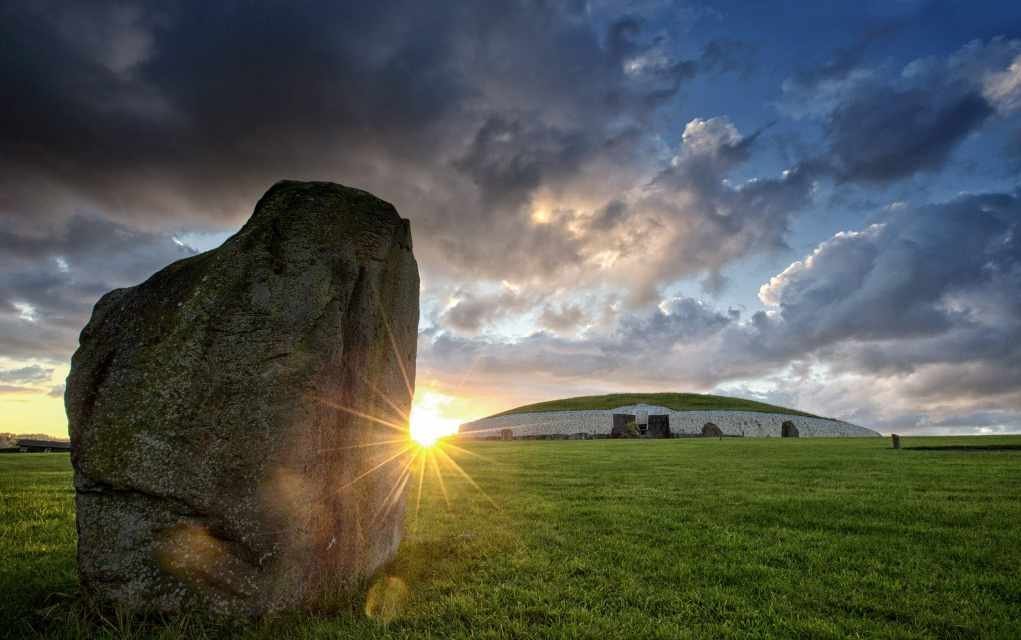
A prehistoric monument north of the River Boyne in County Meath, Newgrange — or “Brú na Bóinne” — was built during the Neolithic period around 3200 BC. It’s made up of a large circular mound with an inner stone passageway and chambers.
Newgrange features prominently in Irish folklore, and during the winter solstice, the shortest day of the year (21st December), as day breaks the first shaft of sunlight enters a small chamber through an opening in the roof box of the passage entrance and lights it up.
Family tickets are available to visit the Exhibition Centre and Newgrange — check current prices before you go.
Ring Forts, Cork

A ring fort is a set of ancient dwellings arranged in circular settlements and enclosed by earth banks. Over the years, many of our ring forts have worn away, leaving only circular mounds of dirt and stone. Folklore says they were magical places once protected by the spells of Druids, and to this day plenty of people believe you’ll be cursed for disturbing a fairy fort!
Cork is home to several ring forts, including the national monument Garranes Ring Fort, believed to be the birthplace of St Finbarr. It’s also been suggested that Cahervagliar Fort is connected to Brian Boru, one of Ireland’s best-known historical figures.
Dunluce Castle, Antrim

The ruins of Dunluce Castle sit on the cliffs of north County Antrim and are only accessible by bridge. Legend says the castle was once haunted by banshees, and in 1639 the castle kitchens — along with the kitchen staff — fell into the sea during a storm. Dunluce Castle was the family home of the McDonnell clan, and it still belongs to them today.
Family tickets are available, and the site opens daily — check the official website for current prices and opening hours.
You May Also Enjoy Best Playgrounds in Ireland Recommended by Parents
Giant’s Causeway, Antrim

Legend tells us the Giant’s Causeway was formed after a duel between the Irish giant Finn MacCool and the Scottish giant Benandonner.
It’s an area of roughly 40,000 interlocking basalt columns, which we now know was caused by a volcanic eruption — not nearly so fascinating a tale!
Owned and managed by the National Trust, it’s one of the most popular attractions in Northern Ireland. Family tickets are available, and booking online in advance can work out cheaper — check the current prices before your visit.
You May Also Enjoy Terrific Places to See Dinosaurs In Ireland
Glendalough, Wicklow

A stunning national park hidden amongst the Wicklow mountains, Glendalough is one of Ireland’s most visited destinations, world-famous for its Monastic Site and Round Tower.
Legend has it that here at the “Glen of Two Lakes”, as St Kevin prayed, a blackbird laid an egg in his open hands, and he stayed completely motionless until the egg hatched.
There’s an education centre near the Upper Lake, an information office with a small exhibit on local wildlife, and a playground for the little ones on site.
It’s free to visit the round tower, churches and the lakes. There’s a fee for parking in the car park at the Upper Lake, and for the visitor centre.
Hill of Tara, Meath

Located near the River Boyne in the Boyne Valley, the Hill of Tara has a number of ancient Celtic monuments covering it. According to tradition, it was the seat of the High King of Ireland, with some 140 kings said to have reigned in the name of Tara. Other folklore says it was where kings were inaugurated, and it served as an important meeting point, as there was no defensive structure surrounding it.
One of the main attractions at the Hill of Tara is the Lia Fáil, or the Stone of Destiny.
It’s free to visit the Hill of Tara. There are public parking spaces, a coffee shop, and guided tours are available on request for a small charge.
The Jumping Church, Louth

According to legend, the west gable of the Jumping Church, which dates back to the 14th century, jumped two feet inside the wall of the original foundations when an individual of “inappropriate reputation” was buried within the grounds — causing the structure to move in disgust.
The Jumping Church can be found in Milockstown, Ardee. Parking is limited, but it makes a great afternoon or day out for the family, trying to solve the puzzle for yourselves.
Tory Island, Donegal

Located just 9km off the coast of Donegal, Tory Island is roughly three kilometres long and one kilometre wide. Its old name, “Toraigh”, leads some to believe it was once a place of pirates!
On Tory Island you’ll find a large wishing stone, “Leac na Leannán” in Irish — a flat-topped rock standing high above the Atlantic Ocean. The wishing stone invites visitors to make a wish, but it’s only granted to those brave enough to climb the steps to the rock and succeed in throwing three stones onto it in succession.
Ferries generally run from Donegal during the summer months — check current timetables before you travel.
Magic Road, Waterford
Ireland’s famous “magic road” is located along the beautiful countryside close to Mahon Falls in the Comeragh Mountains. If you stop your car in the right spot, put it into neutral and take your foot off the brake, the car appears to roll uphill!
The Magic Road is also known as Fairy Hill — the land where fairy magic trumps gravity. Near the foot of the hill stands a Wishing Tree, which makes a good starting point. There’s also a boulder nearby with the words “Magic Road” carved into it.
The GPS coordinates for the Magic Road in Waterford are 52.2163, -7.5311 — and if you visit, let us know in the comments whether you rolled uphill!
You May Also Enjoy Best Family Friendly Hotels with Pools in Ireland
The Crypt at Christchurch Cathedral, Dublin

You can explore the medieval crypt at Christchurch Cathedral, one of the largest in Britain and Ireland, and the earliest surviving structure in the city. Be sure to look out for the “Cat & the Rat”, a mummified cat and rat who are among the most unusual — and most popular — inhabitants of the crypt. Mentioned by James Joyce in Finnegans Wake, they’re known locally as “Tom & Jerry”.
The crypt also houses fascinating memorials, the Treasury, an audio-visual presentation, the cathedral shop and the Cathedral Café.
It’s free to visit Christchurch Cathedral if you’re attending a service. At other times there’s an entry fee, with family tickets available — check the cathedral’s website for current prices. You can also purchase combined tickets that include Dublinia, where you can learn about the citizens of Dublin throughout the ages.
Queen Maeve’s Grave, Sligo

A three-hundred-metre limestone hill sits at Knocknarea, Sligo, and it’s believed that Queen Maeve, a figure from Irish mythology, is buried inside.
Although it has all the classic hallmarks of a tomb, we still don’t know for certain whether she lies inside — it remains one of the largest unexplored monuments in Ireland.
You can climb Knocknarea and take in breathtaking views of the surrounding countryside, including Ben Bulben, Slieve League and other famous Irish landmarks.
Tír na nÓg, Kerry

In Irish mythology, Tír na nÓg is said to be the land of the young — a place of everlasting youth.
Legend tells that Oisín, son of the legendary Fionn MacCool, saw a white horse in the distance with a beautiful young woman on its back, surrounded by a golden light. Her name was Niamh, daughter of the King of the mystical land of Tír na nÓg. Oisín fell in love and went with her to this land where sadness was unknown. But before long he missed his homeland and begged Niamh to let him return for a visit. She agreed, on the condition that he never set foot on the ground, or he would have to remain there forever.
Time moves differently in Tír na nÓg, and 300 years had passed at home — his family’s castle now lay in ruins. Shocked by what he saw, Oisín fell from the horse while trying to help an old man, and instantly aged those 300 years. He died soon after, and his legend lives on.
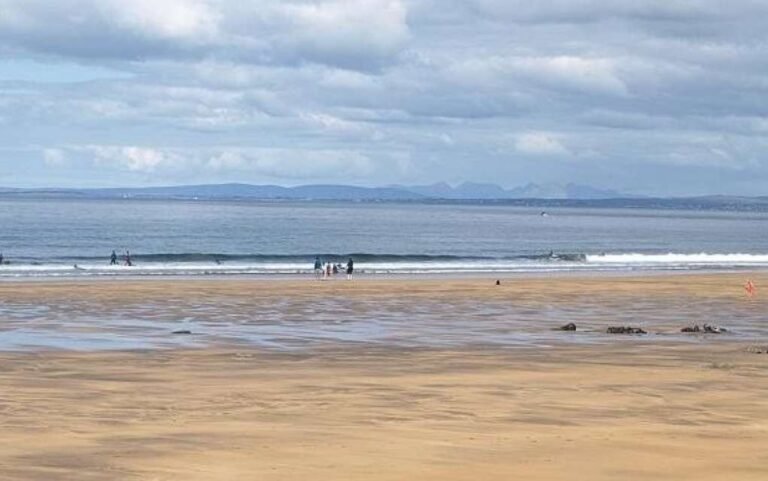
Tír na nÓg beach can be found in Glenbeigh, County Kerry, where there’s also a lovely playground on the Rossbeigh side of the town.
You May Also Enjoy Parents Recommend the Best Sandy Beaches in Ireland
Dunseverick Castle, Antrim

Born at Dunseverick Castle, Deirdre — who became known as Deirdre of the Sorrows — was declared beautiful by the druid Cathbad of Ulster. He prophesied that her beauty would grow as she aged, and that she would become the most beautiful woman in Ireland — but that her beauty would bring sorrow, and war upon her country.
King Conchobhar had her placed in the care of the poetess Leabharcham and vowed to marry her once she came of age, hoping to spare his country from war.
Years later, Deirdre fell in love with a young man who turned out to be related to the man who had once cursed her. With her family’s help she fled, only returning once tricked by the King. The King had her love killed and kept her hostage. After a year of silence, he offered her to the man who had killed her love, and she threw herself from her chariot and died.
The last remains of Dunseverick Castle can still be seen along the Antrim coast, near the Giant’s Causeway.
You May Also Enjoy Top Spots in Ireland for Swimming and Splashing Family Fun
Allihies Beach, Cork

Allihies is a small seaside town best known for its connection to the mythical story of the Children of Lir.
The children of King Lir and his wife Eve were Fiachra, Conn, Aodh and Fionnuala. Members of the Tuatha Dé Danann, Eve was the first daughter of King Bodb the Red.
Legend has it that when Eve died, Lir married King Bodb the Red’s second daughter, Aoife, who soon grew jealous of the children and the devotion Lir showed them.
Aoife brought the children to Lough Derravaragh to drown them, but Fionnuala used her powers to turn her brothers and herself into swans. Aoife cursed them to spend 300 years on the lake, 300 years on the Sea of Moyle, and a final 300 years at Irrus Domnann in Mayo. The spell could only be broken when the swans heard the sound of a Christian bell.
The swans could still speak and sing with their own voices, and as they flew to the Beara Peninsula in Cork, they were drawn to a bell ringing in Allihies. There they were transformed back into human form — though by now very old, as so much time had passed. It’s said that a hermit saint, Mochaomhóg, found them and baptised them before they died. They were buried in Allihies under large white boulders.
The boulders can still be seen near Allihies beach today — do look out for the sign, as it can be easy to miss!
You May Also Enjoy 9 Amazing Adventure Centres for Families in Ireland
The Book of Kells, Dublin

The Book of Kells is housed in the library at Trinity College, Dublin. It was created by Columban monks around 800 AD and is an ornately decorated Gospel manuscript in Latin, said to be one of Ireland’s finest national treasures and a masterpiece of calligraphy and insular illumination.
The manuscript takes its name from the Abbey of Kells, where it remained for many centuries before being put on public display at Trinity College.
The Book of Kells Exhibition brings visitors back through the centuries, exploring the monks who created it and how it has survived for over 1,200 years.
Family and individual tickets are available to visit the library and the exhibition — check the Trinity College website for current prices.
You May Also Enjoy Places to Find Magical Fairy Trails in Ireland
Ireland’s landscape is scattered with places like these, where history and legend blur together — and there’s always another mythical corner waiting to be discovered.

Frequently Asked Questions
What’s the most famous mythical place to visit in Ireland?
Newgrange and the Giant’s Causeway are probably Ireland’s best-known mythical and folklore sites, but there are magical spots in every county — from the Hill of Tara to Tír na nÓg beach in Kerry.
Are these mythical and folklore sites suitable for a family day out?
Many of these places have visitor facilities such as playgrounds, cafés or education centres, which makes them well suited to a family visit. Facilities and accessibility vary from site to site, so it’s worth checking each location’s own information before you travel.
Do I need to book tickets in advance?
It depends on the site and the time of year. Popular spots can get busy, especially in peak season, so booking online in advance where it’s offered is usually a good idea. Check each attraction’s website for its current booking options.
When is the best time to see the Newgrange winter solstice light?
The solstice illumination happens each year around 21st December, the shortest day of the year, when the first shaft of sunlight lights up the inner chamber at daybreak.
Are any of these mythical places free to visit?
Yes — several, including the Hill of Tara and the round tower, churches and lakes at Glendalough, are free to visit, while others such as castles and exhibitions charge an admission fee. Check each site’s website for current details.
More Adventures to Explore
If you enjoyed this journey into Ireland’s myths and legends, you might also like:
- Take a Fairytale Road Trip Around Ireland
- Best Playgrounds in Ireland Recommended by Parents
- Terrific Places to See Dinosaurs In Ireland
- Best Family Friendly Hotels with Pools in Ireland
- Parents Recommend the Best Sandy Beaches in Ireland
- Top Spots in Ireland for Swimming and Splashing Family Fun
- 9 Amazing Adventure Centres for Families in Ireland
- Places to Find Magical Fairy Trails in Ireland
Save This for Your Next Family Day Out
Fancy exploring more of Ireland’s magical side? Browse our full collection of adventure ideas for families and bookmark this page so you’ve got your list of mythical and folklore places ready for your next road trip.
Don’t miss our best content straight to your inbox! Sign up now for our free weekly newsletter, packed with family day-out ideas, recipes, parenting tips and great competitions.