
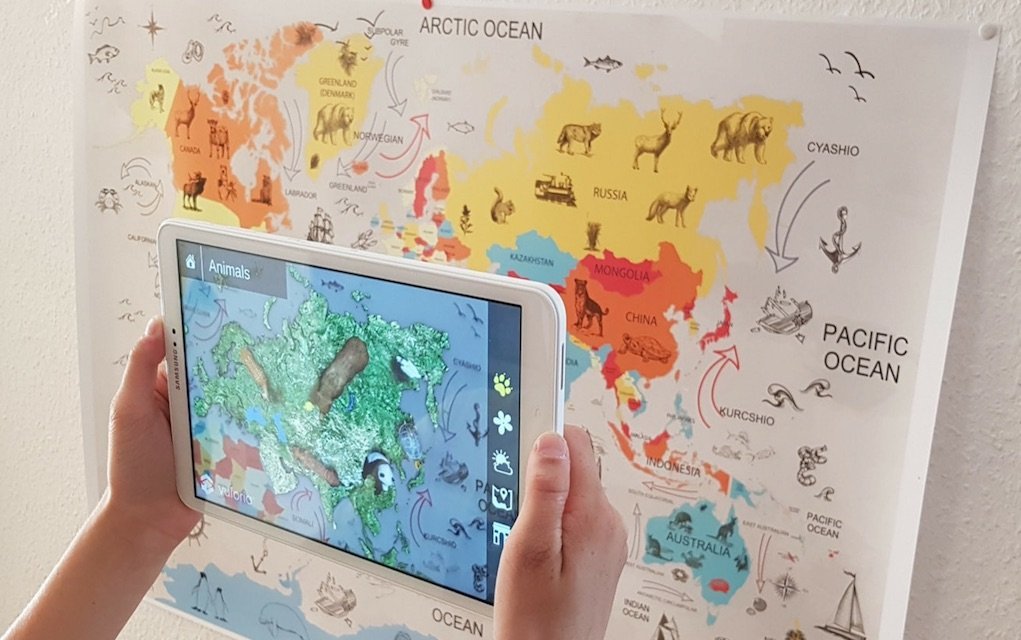
Have you been hearing a lot about AR, or Augmented Reality, and wondering what it actually is? Here’s our quick parent’s guide to augmented reality technology — what it means, where your kids are probably already using it, and why it’s worth understanding.
What is Augmented Reality?

In simple terms, augmented reality technology is a way to digitally bring real-world images and objects to life. It creates 3D versions of things, adds sound and touch capabilities, and lets you view and manipulate images from different angles.
Augmented Reality, or AR for short, works by producing a computer-generated image on top of the user’s real-life environment, usually viewed through the camera on a phone, tablet, or headset.
There are four main types of augmented reality technology:
- Image Recognition uses the camera on your smartphone or tablet to read and translate an image, such as a QR or 2D code, to produce instructions or a 3D graphic from the data stored within it.
- Projection AR projects light onto surfaces or into midair to show an image or hologram that a user can manipulate by touch.
- GPS AR tracks a device by sending location and time signals to GPS receivers, which then send information based on your location back to the device. We use this constantly when we navigate while driving or walking.
- Superimposition AR lets you view an object in place before you commit to it. Paint and furniture companies use this well — their apps let you see what a colour will look like on your wall, or how a piece of furniture will look in your home, usually by pointing your phone or tablet at the space.
What Parents Need to be Aware Of

Remember when your child was mad about Pokémon Go? That was one of the first uses of augmented reality to really hit the mainstream, and it’s a good example of how AR can turn an everyday walk into an adventure.
Many children are already using augmented reality in their day-to-day lives, whether through games or through animated filters on apps like Snapchat and Instagram.
Parents use AR too, often without thinking about it — QR codes, Google Maps navigation, or watching sports on TV with scores and graphics overlaid on the pitch. If you’ve ever used an app to preview paint colours or furniture in your home, that’s AR as well.
AR is here to stay, so it’s worth knowing what it can do for your family in everyday life.
You might also enjoy reading 5 Easy Ways to Turn Screen Time into Quality Time.
Why is AR Good for Kids for Education?

Bringing AR into the classroom builds on what students already know. AR lets a student keep engaging with both the teacher and their classmates while giving them a way to interact with and visualise what they’re learning — which helps make lessons stick.
Using augmented reality in the classroom, or at home during homework, can be an effective way to help students engage with subjects that might otherwise feel dry. Because it’s interactive, it gives kids another way in to understanding and remembering what they’ve learned.
As one example, Dublin-based technology company CleverBooks uses augmented reality to bring school subjects to life, supplementing the curriculum and helping kids learn independently through seeing, hearing and doing. A few examples of how this looks in practice:
- In Geometry, students can drag and move 3D shapes, observing what happens as they change the angles of particular vectors — putting classroom concepts into practice visually.
- In Science, students can view a 3D image of vital organs to better understand how they work.
- In Engineering and Design, AR lets students move and test solutions before building them for real.
- In subjects like Geography and History, AR can bring maps and timelines to life.
This kind of immersive learning is designed to help kids engage more with tricky subjects and build skills that matter for modern classrooms and workplaces.
You might also enjoy reading How to Make Homework Shorter and Keep You and Your Child Happy.
What’s Next for AR?
The outlook for AR keeps growing as more companies and organisations put it to use for everyday consumers.
- AR is already at work in hospitals and doctors’ offices — vein-finding scanners project where veins and valves are so healthcare professionals can more easily find a vein for IV placement.
- Travel is another growing area, with the idea of pulling up useful information the moment you reach a particular location.
- Shopping is changing too, as more retailers bring AR into the customer experience.
- Homes and real estate are being planned in new ways. Take a look at IKEA’s Place app for a taste of what’s to come:
Frequently Asked Questions
Is augmented reality the same as virtual reality?
No. Virtual reality replaces your surroundings entirely with a digital environment, usually through a headset. Augmented reality adds digital elements on top of the real world you can still see around you, typically through a phone, tablet, or AR glasses.
Do I need special equipment for my child to use AR?
Not usually. Most AR experiences kids encounter, from games to app filters to educational tools, work through the camera on an ordinary smartphone or tablet. Some more advanced AR uses dedicated headsets, but that’s not required for most everyday or classroom use.
Is augmented reality safe for kids to use?
As with any screen-based activity, it’s worth applying the same sense you would to any app or game: check age ratings, be aware of what a game or app collects or shares, and keep an eye on how much time your child spends using it. AR itself isn’t inherently more or less safe than other screen activities — it comes down to the specific app or platform.
How is AR used in schools?
Teachers and education companies use AR to make subjects like geometry, science, engineering and geography more interactive, letting students visualise and manipulate concepts rather than just reading about them. It’s used both in the classroom and, increasingly, for homework support.
What’s a simple example of AR my family might already use?
If you’ve ever used Google Maps navigation, watched a sports broadcast with on-screen graphics overlaid on the pitch, or used a filter on Snapchat or Instagram, you and your family have already used augmented reality.
Related Articles
- What Parents Should Know About Pokémon Go
- 5 Easy Ways to Turn Screen Time into Quality Time
- How to Make Homework Shorter and Keep You and Your Child Happy
Explore More Family Tech Ideas
Curious about other ways technology is shaping how kids learn and play? Browse our family life hub for more practical guides like this one, and save this article to come back to next time AR comes up at the dinner table.
Don’t Miss an Idea
Want more guides like this one delivered straight to your inbox? Sign up for our free monthly newsletter for parenting tips, family ideas, competitions and offers — it’s free, and you can unsubscribe any time.