
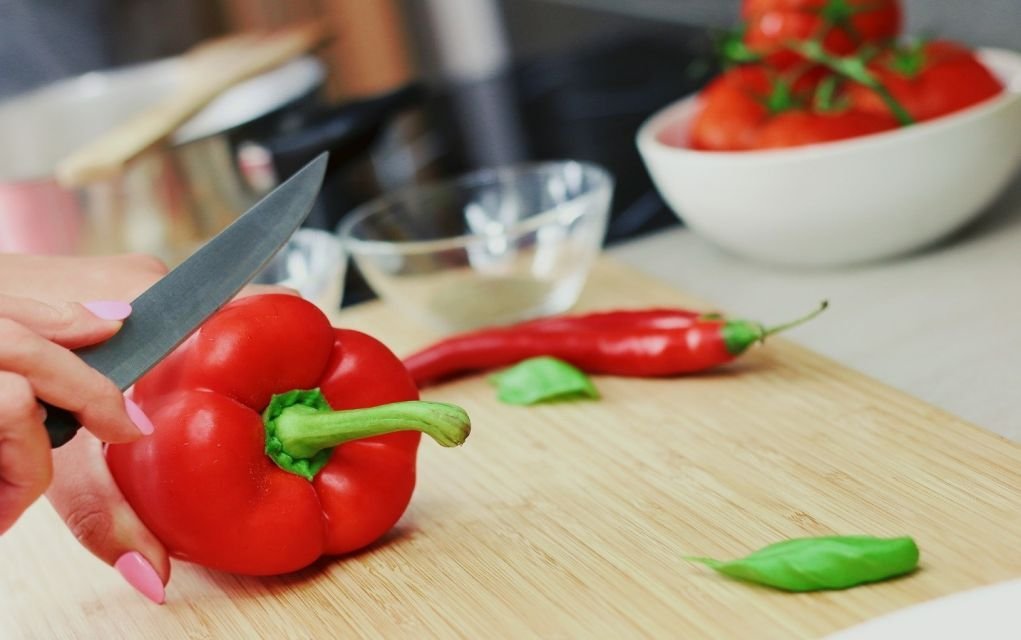
Knives are one of the most useful tools in any kitchen — and one of the few that can genuinely hurt a curious child or a distracted parent if they’re not handled well. The good news is that knife safety isn’t complicated. A handful of simple habits, followed consistently, make a real difference.
Here are 5 simple kitchen safety rules for knives that the whole family can learn together.
#1. Keep Knives Sharp

It sounds counterintuitive — surely a sharp knife is more dangerous than a dull one? In fact, it’s the opposite. A dull knife needs more force and pressure to cut through food, which makes it far more likely to slip and cause an injury.
The simplest way to keep both yourself and your knife safe is to sharpen it every two to three months, using either a sturdy sharpening stone or a knife sharpener. If you’ve invested in a set of chef’s knives, it’s also worth using a sharpening steel for quick touch-ups between full sharpening sessions.
If you’re shopping for a set of knives, Chef Knives Expert has reviews and buying guides worth a look. A magnetic knife sharpener that fixes to the wall or a cooker canopy is a handy option for keeping a sharpener within easy reach without it taking up drawer space.
#2. Practice Knife Techniques

Knowing how to use a knife properly prevents just as many injuries as keeping it sharp. A few basics go a long way:
- Always hold the food you’re cutting with one hand, while the other hand does the cutting. Shape the holding hand like a claw, with fingertips tucked under and out of the knife’s path.
- Use a cutting board every time — and choose a board large enough that you’re not working in a cramped space.
- Keep the tip of the knife on the board, and rock the handle up and down to cut, rather than lifting the whole blade away from the surface.
- For round fruit or veg, cut in half first, then rest the flat side down on the board before slicing further. This keeps the food stable and stops it rolling.
- If a knife slips from your hand, let it fall. Never try to catch a falling knife.
- When carrying a knife, always point the tip towards the floor.
This handy tutorial from Jamie Oliver gets you chopping quickly and correctly with the right knives:
#3. Safe Knife Storage

With kids around, safe storage matters as much as safe use. If your knives didn’t come with a block, it’s worth getting one, or choosing a spot well out of small hands’ reach.
A magnetic knife strip fixed to the side of a cabinet, up high near the cooker, works well and keeps blades visible but inaccessible to little ones. If you’re storing knives in a drawer, keep them pushed to the back, away from small fingers reaching in.
Tip: Never leave a knife unattended on the counter. If you need to step away, put it away first. Better safe than sorry.
#4. Clean Knives Frequently
Leaving knives sitting in soapy water lets dirt and food debris build up on the blade, which dulls it over time — and a dull knife, as we’ve seen, is a less safe knife.
Check the instructions that came with your knives to see whether they’re dishwasher-safe or need hand washing. If washing by hand, use a little soapy water, rinse well, and dry immediately with a clean cloth rather than leaving it to air dry.
#5. Never Let Young Kids Use Knives Unattended

Introduce knives to your child gradually and carefully, and never leave a child using one unsupervised. Every child is different — you’ll get a feel for when yours is ready to move on to bigger, sharper knives, or to be trusted cutting independently while you handle other kitchen tasks nearby.
 Letting kids cut food themselves helps build independence and real cooking skills, so it’s worth teaching them properly rather than avoiding it. Cover the basics early: never cut towards yourself, and never pick up a knife by the blade.
A butter knife is a good, low-risk starting point — let them practise on something soft like a banana before moving on to anything sharper. A nylon kids’ knife set is another good option for early practice, letting them build confidence without the worry of a real blade.
You might also enjoy reading Useful Kids Cooking Skills Easily Mastered by Preschoolers.

Frequently Asked Questions
At what age can kids start using a knife safely?
There’s no single right age — it depends on the child’s coordination, concentration and confidence. Most families start with supervised butter-knife practice on soft foods before moving on to anything sharper, always with an adult close by.
What’s the safest way to store kitchen knives with young kids around?
Keep knives somewhere small hands can’t reach — a wall-mounted magnetic strip fitted high up, a knife block kept out of reach, or a drawer with knives pushed well to the back are all good options.
Why does a sharp knife matter for safety?
A sharp knife needs less force to cut through food, so it’s less likely to slip. A dull knife requires more pressure, which increases the chance of an accident.
Should young kids be allowed to use real knives at all?
Supervised, age-appropriate knife practice can build genuine cooking confidence and independence. Start with something soft and blunt, like a butter knife, and only progress as your child shows they can handle it safely — always supervised.
Related Articles
- Useful Kids Cooking Skills Easily Mastered by Preschoolers
- Fun and Easy Recipes to Cook With Kids
- Getting Kids Involved in the Kitchen
Save These Kitchen Safety Rules
Bookmark this page or save it to your parenting folder so you’ve got these five rules handy next time you’re teaching a child to use a knife in the kitchen.
Want More Family Kitchen Ideas?
Sign up for our free newsletter for weekly ideas, recipes, competitions and offers straight to your inbox — it’s free, and it’s full of practical stuff for busy family life.