
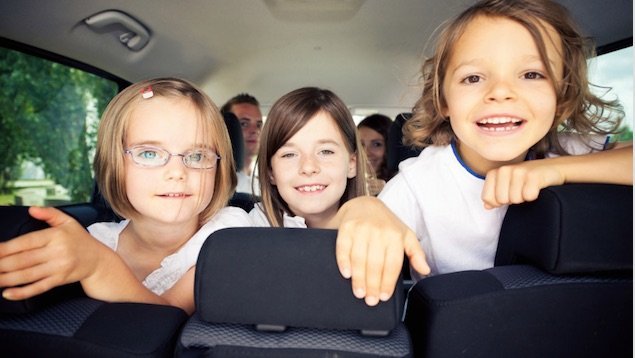
What is it about lengthy family car journeys that brings out the worst in all the passengers? Perhaps it’s the long drawn-out time cooped up in a small space, or the incessant “Are We There Yet”s?” from the backseat. As a regular car driver, and Mum of two, here are 11 Proven Car Journey Tips to Avoid the Dreaded “Are We There Yet? question when travelling with kids (even the big kids!).
Sign up for our free Newsletter stuffed full of ideas, competitions and offers. PS Did we mention it’s free?
#1. Planning is Key

Before you get asked the dreaded question, know what the answer will be!
- If you don’t have a sat nav, consider printing out your route in advance. Most route finders will give you an estimated journey time, so you are armed with that knowledge before setting off.
- Decide on the best time to leave, sometimes you can plan your trip around nap or bedtime. By changing the kids into pj’s before you head off, they can then be easily popped, sleeping, into their beds at your destination.
- Decide before you leave who is driving. If you are not the driver, don’t backseat drive. You know who you are!
- Do some research before you head off and know where would be the best places to take a break.
#2. Packing is a Close Second
What you pack for use inside the car can be as important as what you pack in the bags in the boot.
- For younger children have a selection of toys that can be clipped to their car seat so that you don’t spend the whole journey picking up toys that have dropped.
- Pack some suitable snacks and drinks for everyone.
- Ensure you have a packet of wet wipes in the car.
- Even if your children are toilet trained, a portable potty can be a very useful addition. And can come in useful if anyone suffers from travel sickness.
- Have a change of clothes handy, just in case.
- Ensure any special teddies or blankets are inside the car (and not packed in the boot) before you set off, particularly if you might want the kids to snooze en route.
- Make sure you have a first aid kit and a torch to hand.
#3. Audio CD’s or Podcasts

My children love to read, but not everyone can read in the car. When we go on longer journeys I have a stash of Audio CD’s that they love to listen to. My girls both love Horrid Henry and anything by David Walliams.
You will be surprised how well they work on children of all ages, and soon puts an end to bickering and boredom.
Pre-recorded podcasts can also work well. Radiolab is a radio show and podcast weaving stories and science into sound and music-rich documentaries. Other recommended podcasts for older kids include AstronomyCast or Stuff you should know.
Alternatively, subscribe to Audible.co.uk or Audible.com which allows you to download books for a monthly subscription. There’s a free trial available and you can cancel subscription at any time. The app is available on Android and iOS.
If you are feeling brave, get the children to create a playlist for the car journey, and let them do some sing-a-longs.
#4. Puzzle Books, Sheets & Colouring Pages
 Print off a variety of games such as our Car Journey Puzzles Sheet or colouring pages and pop into a folder for the journey.
Sudoku, Crosswords or simple puzzle books can also be great for car journeys.
Sticker books are perfect to keep younger members of the family amused on long car journeys. Especially if they have re-usable stickers.
#5. Car Journey Games

There are classics like I-Spy, although you have to be patient with children when they have spotted something beginning with ‘C” 20 minutes ago and are shocked when nobody can guess what it is. When my girls were younger we used to play with colours so I spy with my little eye something green etc.
Other good car journey games include:
- Licence Plate – See how many cars you can spot from the same year or the same state, first to reach 10 is the winner.
- Car Colour Game – Good for children too young to play the licence plate game. Everyone picks a colour and they have to spot cars in this colour, first to reach 10 is the winner. My advice would be to go for more unusual colours or the game will be over very quickly!
- As a twist on this game why not spot cars makes so VW, BMW, Lexus, Ford etc.
- Can you get anyone to wave back car game.
- Count the number of……bridges, road signs, etc. along the way.
#6. Tall Tales

- A good way to pass the time is to get everyone to tell a story, or try out a tongue twister or riddle.
- Or get one person to say the first line and everyone has to add a line and see where the story takes you!
- Or play Who am I? One person is on and they can be an animal, object, person, place etc and everyone gets to ask them questions to try and guess who or what they are. Or you can give them clues and they all get to guess each time you give them a clue.
#7. Car Journey Toys
Pack some suitable car toys to keep children amused on longer car trips.
- Mini or magnetic board games such as chess, Connect 4, Othello or Guess Who? work well.
- For younger children, toys that can be clipped to a car seat are good, thus avoiding you having to turn around and retrieve dropped toys regularly!
- Colouring games which work with water filled pens can be fun for the car, as once they dry, you can start all over again. So crank the heat up!
- Rubix Cube, or similar puzzles, are perfect for passing the time on a long car journey.
- Pack a tray for each person and then can play paper folding games or cards.
- Loom bands are great for cars – fill a plastic container with loom bands for each child.
- Lego – Fill a child’s lunchbox with lego pieces and affix a small board to the lid for their creations.
- Knitting can also help pass the time and keep everyone calm and relaxed.
#8. Refreshment Stop
 Break up the car journey with a stop for refreshments and a run around for the children.
If you are traveling by day, consider packing or buying a picnic and stopping at a picnic spot near a play area, preferably with toilets. Or you could come off a main road and visit a smaller town to have a toilet break and some refreshments.
For night time driving, stopping at a 24 hour services facility is probably the best option.
Be sure to plan stops into your car journey and add 30 to 50 minutes onto your travel time for each stop. This is really important, not just for the children, but to ensure you don’t get too tired either.
Consider adding a ‘safety spot’ sticker to your car for each child. They put their hand on it while you are loading and unloading the car. Ensuring nobody wanders off.
#9. Read
Pack books for children who can read in the car. The car journey could be used as study time for older children. Although you may get some protests for that suggestion!
#10. Technology
Many newer cars have built in technology including DVD players and USB points. If your car doesn’t, and you make regular car journeys with the family onboard, it may be worth investing in a portable DVD player, or a Wi-Fi dongle, to allow the children to watch a movie on the trip.
If your children are lucky enough to own their own player or device to listen to music, play games or watch a movie or video, make sure to pack headphones for each one. If children wish to watch or listen to the same thing you could purchase a headphone splitter which allows you to run multiple headphones off the same device. Ours have been invaluable!
#11. Bribery
 As a last resort I see no shame in bribery.
It could be that you offer a reward to children if they can go the whole journey without saying “I’m Bored” or asking ‘Are we there yet?” or without arguing with their siblings, or you!
The reward could be a fun activity while away from home or a small treat per hour they get through. Or that they can use their devices for the last hour of the journey.
Safety Tips for Family Travel in the Car

Keeping your kids entertained is one thing but safety is paramount.
For Mom’s and Dad’s:
- Make sure your vehicle is in full working order: Check dashboard lights, oil, water, lights, break lights tyres.
- Wear your own seat belt – set a good example
- It’s easy to speed up on the open road so keep an eye on that speedometer
- Leave plenty of time for your journey. Don’t rush – you’ll probably just be racing to the next set of traffic lights anyway!
- Don’t drive while tired – plan long journeys to include rest breaks
- Have an emergency kit for the car and a first aid kit, just in case
- Never leave your child unattended in the car, even for just a minute.
- Should you need to pull over in a hurry, remember to do so in a safe place, use your hazards where necessary and remember you cannot stop on the hard shoulder of a motorway
- It goes without saying but never, ever drink and drive. Even a single drink can impair your judgement
For the kids:
- Make sure your child is in a suitable child car seat or seat belt. For infants under 1 they should face the rear when travelling. Make sure you follow the owner’s manual instructions on car seats and booster seats.
- Ensure the child seat is securely fitted – check every journey.
- Have the child locks on the car doors activated
- Be careful with the toys and snacks you give children and in particular small children. Avoid choking hazards.
Over to you! Have we missed anything? Add your tips to the comments box below.