
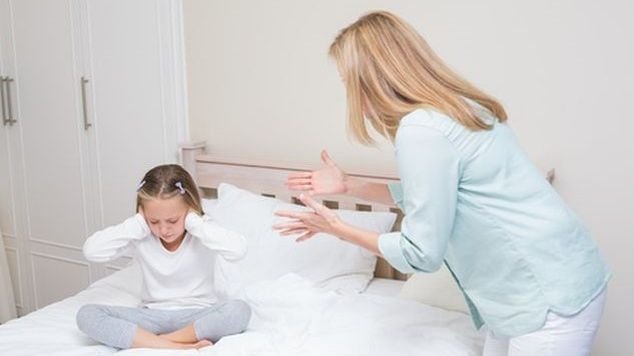
Do you find your patience being stretched as a parent? Would you like to know how to parent without yelling? Parenting expert and author Val Mullally shares her 10 simple ways for parents to stop themselves yelling at kids — and what to do when kids won’t listen.
Karen glimpsed herself in the mirror. ‘Is that me!’ That reflection. That red-faced, roaring woman. Was that how her children would remember her? She’d always thought that parenting without yelling would be as normal as building sandcastles on the beach.
How did her peaceful, calm home get swept away? “I don’t want to be yelling and roaring at my kids,” she thought. “How did I let this happen?”
She’d always imagined she’d be a loving, relaxed mum. She’d imagined a loving, peaceful home — not this war zone of constant battling.
Eat your food. Get ready for bed. Stop that fighting. It wasn’t just her barrage of instructions that concerned her.
When did I start barking orders like a sergeant major? Why am I always yelling at my kids? Is parenting without yelling even possible?
If you identify with Karen’s experience, you’ll be glad you’re reading this, because your interactions with your children can be different. We don’t have to yell at our kids. The moment we recognise the trap we’ve fallen into, we can start figuring our way out of it.
I don’t think any of us as parents deliberately set out to yell at our kids. It probably began when our dear little baby morphed into an ultra-mobile toddler capable of exploring pretty much anything and everything we didn’t want explored.
One day we used an extra-loud “No!” and — boom — the child listened.
That big voice was probably as much a surprise to us as it was to our child. Our yell worked, so we used it again, and again. And when it didn’t work so well, we yelled louder.
Over time we learned to yell louder and more often, and our children learned to take less and less notice. The less they listened, the louder we yelled.
Somehow we slid down a slope, without even realising it, until we were caught in a net of yelling louder and more frequently, while our children seemed to become deafer and deafer.
For every action there is a reaction. You may have noticed that when you yell, your child:
- develops selective deafness
- ignores your demands
- withdraws from you
- makes excuses
- becomes aggressive or sullen

We can’t expect different behaviour from our children unless we model different behaviour ourselves.
Einstein is often credited with saying that insanity is repeating the same thing again and again while expecting different results. We’re probably all a little insane as parents at times.
The bottom line is that yelling doesn’t get us what we want — a co-operative home — it just adds to the stress.
So how does a parent stop yelling?
You may also enjoy: How to Discipline Your Child — 4 Tips for the Proactive Parent
10 Simple Ways to Stop Yelling at Your Kids
#1. Imagine your child’s experience and reaction to your yelling
Is this really how you want your child to remember you? And is this how you want to remember yourself?
#2. Recognise the yell trap you’ve fallen into
Yell, repeat. Yell, repeat. This cycle is getting you nowhere.
#3. Acknowledge that yelling isn’t working
It isn’t working because the more you yell, the more impervious your children get to your over-loud commands. The louder you yell, the harder it is for them to actually hear you.
#4. Acknowledge that yelling is harming your family relationships
Nobody likes being the yeller, and nobody likes being yelled at. If we want relationships built on equal respect, caring communication and cooperation, it starts with us as adults setting the tone.
#5. Commit to quit yelling
Change the habit. Like any other habit — smoking, overeating — make a conscious decision to quit, and stick to it. You quit smoking by never picking up a cigarette. You quit yelling by never raising your voice in anger or frustration.
It helps to have a clear picture in your mind of what you’ll choose to do differently, rather than yell, when you need to hold a limit.
Take a moment to finish this sentence: “Instead of yelling, I choose to…”
If you’re finding it hard to imagine a calmer way to handle discipline issues, Val Mullally’s book, ‘BEHAVE, What To Do When Your Child Won’t’, is available on Amazon, or you can explore her online parenting course for the three signposts to effective discipline.
#6. Choose to respond, rather than react
The exception is a genuine emergency, where you need to raise your voice to keep someone safe.
Rather than a knee-jerk, unthinking reaction, pause — so that the thinking, reasoning part of your brain can catch up with that first reactive impulse. Ask yourself, “What really matters here?”
When you take that extra moment to think about how your action will impact what happens next, you can choose a more helpful response.
#7. Remember, your child’s behaviour is about them
Your response is about you. Choose to set the example of calm, in-control behaviour.
#8. Not yelling doesn’t mean abstaining from discipline
Your children need you to be the adult — to set clear, firm boundaries that keep them physically and emotionally safe.
#9. Notice your thought patterns
Our children don’t make us mad. Our thoughts about our children make us mad. Here are a few examples of unhelpful parental thinking:
- “He’s trying to control me.”
- “He’s deliberately winding me up.”
- “She’s a brat.”
Thoughts like these increase our stress, and when we’re stressed we’re more likely to react by yelling. Let go of any unhelpful thought the moment you notice it. Remind yourself that all conflict is a protest at disconnection. Keep calm, and figure out how to reconnect.
#10. If you yell, stop and apologise
Tell your child that’s not how you want to be. Don’t make excuses for your behaviour. Focus on your breathing to calm yourself. Remember: it’s your choice to yell. It’s also your choice to respond calmly.
You may also enjoy: How to Avoid Getting Caught in a Power Struggle with Your Toddler
Frequently Asked Questions
Why do I keep yelling at my kids even when I don’t want to?
Yelling often becomes a habit rather than a deliberate choice. It usually starts because it gets a quick reaction, and over time we reach for it more and more, while our children tune it out more and more. Recognising the pattern is the first step to breaking it.
What can I do instead of yelling?
Pause before you react, and decide in advance what you’ll do instead — for example, getting down to your child’s level, using a calm firm voice, or physically guiding them rather than shouting instructions from across the room. Having a plan ready makes it much easier to use in the moment.
Does yelling actually harm my relationship with my child?
Frequent yelling can damage trust and connection over time, and children often respond by withdrawing, becoming defensive, or simply tuning out. Choosing a calmer approach helps build a relationship based on respect rather than fear.
Is it okay to yell in an emergency?
Yes — raising your voice to keep a child safe in a genuine emergency is different from yelling out of frustration. The goal isn’t to never raise your voice at all, but to stop yelling as a default response to everyday frustration.
What should I do if I yell at my child by mistake?
Stop, take a breath, and apologise. Acknowledge that yelling isn’t how you want to communicate, without making excuses. Children learn a lot from seeing a parent take responsibility and choose to do better.
You Might Also Like
- How to Discipline Your Child — 4 Tips for the Proactive Parent
- How to Avoid Getting Caught in a Power Struggle with Your Toddler
- Positive Parenting Tips for Calmer Family Days
Every family has days when patience wears thin — you’re not alone in this. If this article was useful, take a moment to save it or share it with another parent who might need it too.
Want more parenting ideas like this?
Sign up for the MyKidsTime newsletter for a weekly dose of practical parenting tips, activity ideas and family life inspiration, straight to your inbox.